

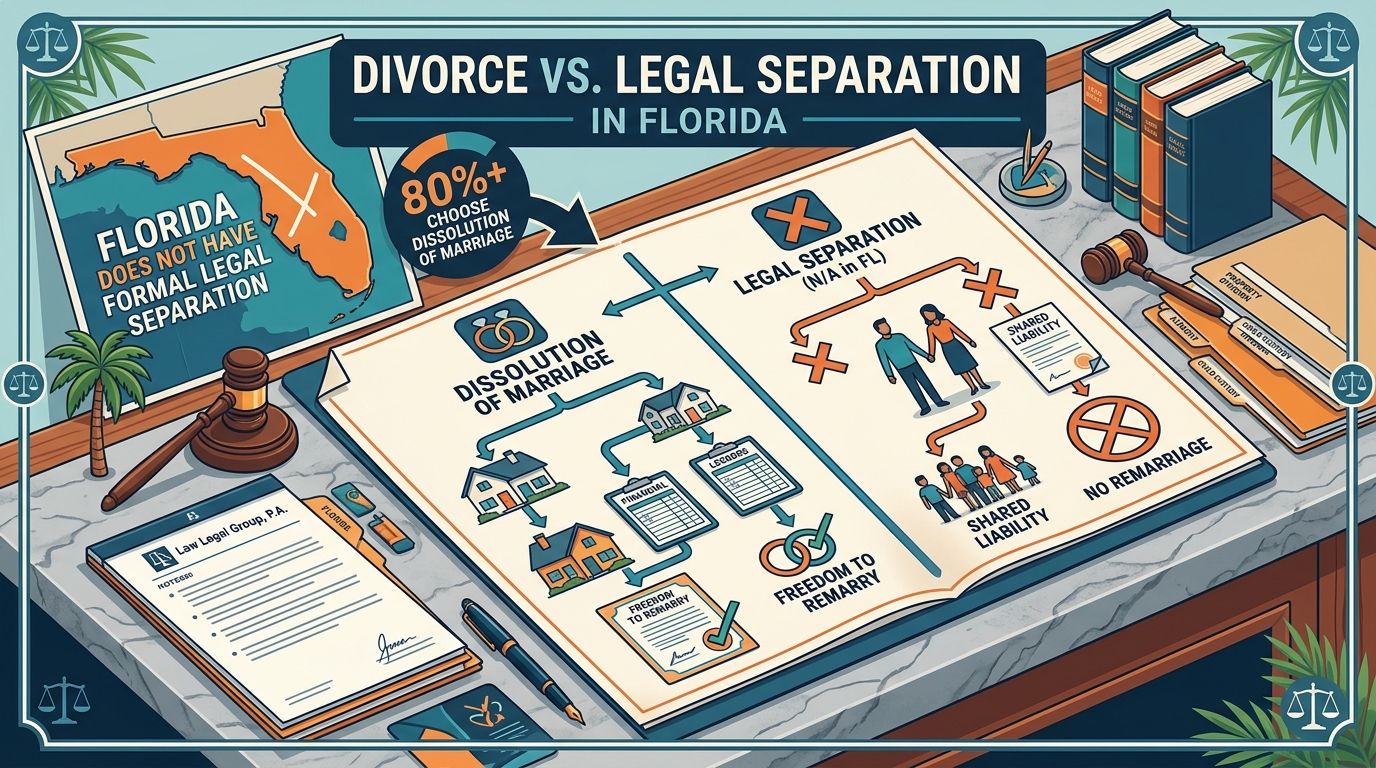
Florida is one of the few states in the United States that does not offer a formal legal separation status for married couples. This unique legal landscape creates significant confusion for residents navigating marital breakdowns. According to recent family law data, over 80% of marital disputes in Florida result in a final judgment of dissolution of marriage rather than a separation agreement. Understanding this distinction is critical because it directly impacts your financial liability, tax status, and ability to remarry. This guide clarifies the operational differences between divorce and the informal separation arrangements available in the state. (Law Legal Group P)
What Is Florida Law Regarding Separation?
Divorce is the legal dissolution of a marriage by a court or other competent body. In Florida, the term "divorce" is technically referred to as a "dissolution of marriage." The state operates as an equitable distribution jurisdiction. This means that assets and liabilities acquired during the marriage are divided fairly, though not necessarily equally, between the spouses.
Legal separation is a court-ordered agreement that outlines the rights and duties of a couple while they remain legally married. While many states utilize this as a distinct legal status, Florida does not. Instead, couples who wish to live apart without ending their marriage must rely on private contracts. These contracts are known as separation agreements. They are binding contracts that govern issues such as child custody, support, and asset division while the marriage remains intact.
According to the Florida Bar, the lack of a formal separation statute means that couples cannot obtain a court order for separation in the same way they can for divorce. This forces parties to draft detailed private agreements to protect their interests. The Law Legal Group, P.A. frequently advises clients on how to structure these agreements to ensure they hold up in court if a future divorce petition is filed.
Divorce vs. Separation: Core Differences
The primary difference between divorce and separation in Florida is the legal status of the marriage. In a divorce, the marriage is terminated. In a separation, the marriage remains legally valid. This distinction has profound implications for your financial and personal life.
When you are divorced, you are free to remarry. You are also no longer liable for debts incurred by your ex-spouse after the final judgment. In contrast, if you are separated, you remain legally married. This means you could still be held responsible for debts your spouse incurs. It also means you cannot legally marry another person until the divorce is finalized.
Another critical difference involves the division of assets. In a divorce, the court divides marital assets and debts. In a separation, the couple must agree on how to handle assets. If they cannot agree, they may need to file for divorce anyway to get a court-ordered division. This often leads to increased legal costs and prolonged conflict.
Marital Dissolution Process
The process of ending a marriage in Florida is governed by specific statutes. Understanding these steps is essential for anyone considering divorce. The Law Legal Group, P.A. provides comprehensive guidance through this complex process.
Grounds for Divorce
Florida is a no-fault divorce state. This means that the court does not require proof of wrongdoing, such as adultery or abuse, to grant a divorce. The only ground for divorce is that the marriage is "irretrievably broken." This standard simplifies the legal process by removing the need to assign blame. It allows couples to focus on the practical aspects of ending their union, such as asset division and child custody.
However, while fault is not required for the divorce itself, it can sometimes influence other aspects of the case, such as alimony or attorney fees. In cases involving domestic violence, the court may issue protective orders. These orders are separate from the divorce decree and are designed to ensure the safety of the victim. The attorneys at Law Legal Group, P.A. are experienced in handling domestic violence cases with the utmost sensitivity and legal precision.
Property Division Rules
Florida law mandates that marital property be divided equitably. Marital property includes any assets or debts acquired during the marriage, regardless of whose name is on the title. This includes homes, cars, bank accounts, and retirement funds. Separate property, which is acquired before the marriage or through inheritance, is generally not subject to division.
The court considers various factors when determining what is equitable. These factors include the duration of the marriage, the economic circumstances of each party, and the contributions of each party to the marriage. The goal is to achieve a fair outcome, not necessarily a 50-50 split. This nuanced approach requires careful legal analysis. Our team at Law Legal Group, P.A. works diligently to ensure our clients receive a fair share of their marital assets.
Separation Agreements Explained
Since Florida does not offer legal separation, couples who wish to live apart must use separation agreements. These are private contracts that outline the terms of the separation. They can cover child custody, visitation, child support, alimony, and property division.
A separation agreement is a legally binding contract. Once signed, both parties are obligated to follow its terms. If one party violates the agreement, the other can file a motion in court to enforce it. However, the agreement does not end the marriage. The couple remains legally married until a divorce is granted.
Separation agreements can be modified or terminated by mutual consent. If the couple decides to reconcile, they can void the agreement. If they decide to divorce, the agreement can be incorporated into the final divorce decree. This can streamline the divorce process by resolving many issues in advance. The Law Legal Group, P.A. helps clients draft robust separation agreements that protect their rights and interests.
When to Choose Divorce or Separation
Choosing between divorce and separation depends on your personal circumstances and goals. Divorce is the appropriate choice if you wish to end the marriage and remarry. It also provides a clear legal resolution to financial and parental issues. Separation may be preferable if you wish to remain married for religious, financial, or insurance reasons but need to live apart.
Consider the following factors when making your decision:
- Religious Beliefs: Some religions prohibit divorce but allow separation.
- Health Insurance: Remaining married may allow you to stay on a spouse's health insurance plan.
- Financial Benefits: Social Security benefits or military pensions may require a certain duration of marriage.
- Emotional Readiness: Separation can provide time to adjust to life apart without the finality of divorce.
It is important to consult with an experienced attorney to determine the best course of action. The Law Legal Group, P.A. offers personalized consultations to help you navigate these complex decisions. We provide clear, honest advice tailored to your unique situation.
Key Takeaways
- Florida does not have a formal legal separation status for married couples.
- Divorce, or dissolution of marriage, legally ends the marital union.
- Separation agreements are private contracts that govern life while married but living apart.
- Florida is a no-fault divorce state, requiring only that the marriage be irretrievably broken.
- Marital assets are divided equitably, not necessarily equally, in a divorce.
- Separation agreements can be incorporated into a future divorce decree.
- Law Legal Group, P.A. has served the Tampa Bay area since 2014.
Frequently Asked Questions
Does Florida recognize legal separation?
No, Florida does not have a statutory legal separation process. Couples must use private separation agreements to govern their rights and responsibilities while living apart.
Can I remarry after a separation agreement?
No, you remain legally married until a divorce is finalized. Remarrying while separated constitutes bigamy, which is a criminal offense in Florida.
How is property divided in a Florida divorce?
Florida uses an equitable distribution model. The court divides marital assets and debts fairly based on various factors, not necessarily equally.
What is the difference between a separation agreement and a divorce decree?
A separation agreement is a private contract between spouses. A divorce decree is a court order that legally ends the marriage and resolves all related issues.
Can a separation agreement be modified?
Yes, a separation agreement can be modified by mutual consent of both parties. If one party refuses, the other may need to seek court intervention.
Do I need a lawyer for a separation agreement?
While not legally required, having a lawyer ensures that your rights are protected and the agreement is enforceable. The Law Legal Group, P.A. recommends legal counsel for all separation agreements.
How long does a divorce take in Florida?
The timeline varies depending on the complexity of the case. Uncontested divorces can be finalized in as little as 20 days. Contested divorces may take several months or longer.
Contact Law Legal Group for Expert Legal Advice
Navigating the complexities of divorce and separation in Florida requires experienced legal guidance. The Law Legal Group, P.A. is dedicated to providing compassionate and effective representation. Our team understands the emotional and financial stress of marital breakdowns. We are committed to helping you achieve the best possible outcome.
If you are considering divorce or separation, contact us today to schedule a consultation. We offer personalized legal strategies tailored to your unique needs. Visit our Consultation page to get started. You can also learn more about our divorce services or explore our child custody resources. For more information about our firm, please visit our About Us page. We look forward to assisting you during this challenging time.