

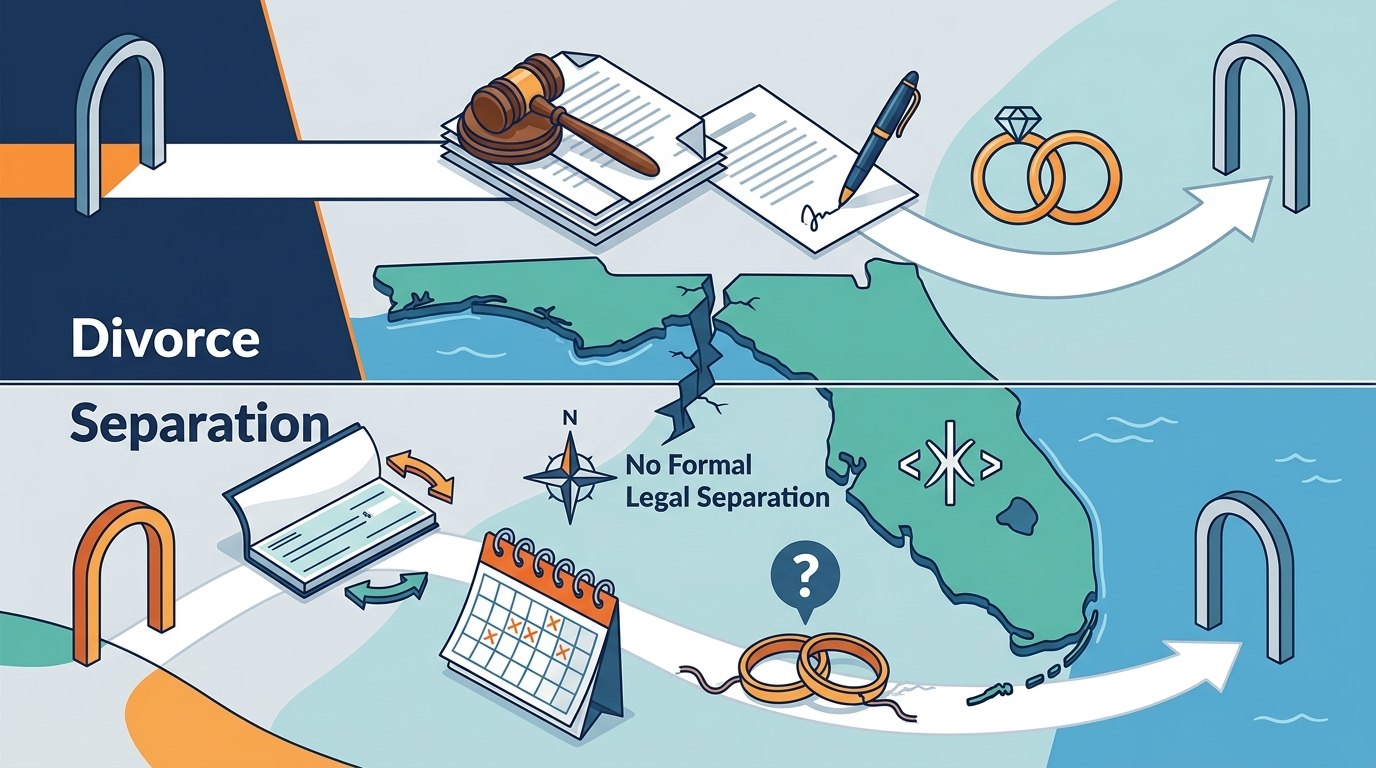
Florida is one of the few states in the United States that does not offer a formal legal separation status for married couples. This unique legal landscape creates significant confusion for residents navigating marital breakdowns. According to recent family law data, over 80% of marital dissolutions in Florida are handled through the divorce process, leaving couples with limited options for structured separation. Understanding the distinction between divorce and the informal concept of separation is critical for protecting your financial and parental rights. (About Us Lawlegalgroup)
What Is Divorce in Florida?
Divorce, legally known as dissolution of marriage, is the only formal way to end a marriage in Florida. It is a judicial process that terminates the legal bond between spouses. In Florida, the law requires that at least one spouse has lived in the state for six months before filing. This residency requirement ensures that the local courts have jurisdiction over the case. (Alimony Lawlegalgroup)
Florida is a no-fault divorce state. This means that neither spouse needs to prove wrongdoing, such as adultery or abuse, to obtain a divorce. The only ground required is that the marriage is irretrievably broken. While the fault is not a factor, the consequences of the divorce are far-reaching. The court will divide marital assets, determine alimony, and establish child custody and support arrangements. (Adoption Lawlegalgroup)
At Law Legal Group, P.A., we guide clients through the complexities of asset division and support calculations. Our approach ensures that your financial future is protected while navigating the emotional challenges of ending a marriage. We provide personalized strategies tailored to your specific circumstances.
The Reality of Legal Separation in Florida
Many couples assume that a legal separation is a standard legal status available in all states. This is a common misconception. Unlike states such as New York or California, Florida does not have a statute for legal separation. There is no court order that formally declares a couple legally separated while remaining married.
However, couples can achieve many of the same practical results through other legal mechanisms. A formal definition of legal separation is a court order that addresses financial and parental issues while allowing the couple to remain legally married. Since this specific order does not exist in Florida, couples must look to alternative legal tools.
Without a formal separation status, spouses remain legally married. This means they are still responsible for debts incurred by the other spouse unless a specific agreement states otherwise. It also affects tax filing status and eligibility for certain spousal benefits. Understanding these implications is vital before deciding on a course of action.
Key Differences at a Glance
Choosing between divorce and an informal separation requires a clear understanding of the legal outcomes. The table below summarizes the primary distinctions between these two paths in the Florida legal system.
| Feature | Divorce (Dissolution) | Informal Separation |
|---|---|---|
| Marital Status | Terminated | Remains Married |
| Remarriage Rights | Allowed immediately after final judgment | Prohibited (Bigamy) |
| Asset Division | Final and binding court order | Requires private agreement |
| Debt Liability | Allocated by the court | Joint liability persists |
| Legal Oversight | Full judicial supervision | Contractual only |
As noted by legal experts in family law, the lack of a formal separation statute in Florida often leads to disputes over financial responsibility. Without a court order, one spouse may still be liable for the other's debts. This risk highlights the importance of having a robust legal agreement in place.
Alternatives to Formal Separation
Since Florida does not offer legal separation, couples seeking structure often turn to a Marital Settlement Agreement (MSA). This is a legally binding contract that outlines how assets, debts, and child-related issues will be handled. While it does not end the marriage, it provides the same financial clarity as a divorce.
Another option is a Postnuptial Agreement. This is similar to a prenuptial agreement but is created during the marriage. It allows spouses to define their financial rights and obligations while remaining married. This can be particularly useful for couples who are unsure about divorce but need to protect their assets.
For couples with children, a Parenting Plan is essential. This document details custody schedules, decision-making responsibilities, and support obligations. Even without a divorce, a court can enforce a parenting plan if it is incorporated into a legal order. This ensures that the children's needs are met regardless of the marital status.
If you are considering these alternatives, schedule a consultation with our team. We can help you draft agreements that protect your interests and provide peace of mind. Our attorneys are experienced in creating customized solutions for complex family law matters.
When to Take Legal Action
Deciding when to file for divorce or sign a separation agreement depends on your specific situation. If you and your spouse can agree on all terms, you may opt for an uncontested divorce. This process is faster and less expensive than a contested trial. It requires both parties to cooperate and sign the necessary documents.
However, if there are significant disputes over assets or custody, you may need to engage in mediation or litigation. Mediation is a voluntary process where a neutral third party helps you reach an agreement. It is often more efficient and less adversarial than going to court. Our firm offers mediation services to help couples resolve conflicts amicably.
It is also important to consider the impact on your children. Research shows that children benefit from stable and clear parental arrangements. Whether you choose divorce or separation, ensuring that your children's needs are prioritized is paramount. We provide compassionate guidance to help you make decisions that support your family's well-being.
Key Takeaways
- Florida does not have a formal legal separation statute, making divorce the only way to legally end a marriage.
- A Marital Settlement Agreement can provide financial clarity without terminating the marriage.
- Divorce in Florida requires at least one spouse to reside in the state for six months.
- Informal separation leaves spouses legally married, potentially maintaining joint debt liability.
- Law Legal Group, P.A. has served the Tampa community since 2014 with dedicated legal support.
- Uncontested divorces are often faster and more cost-effective than contested trials.
- Parenting Plans are essential for protecting the interests of children in any marital breakdown.
Frequently Asked Questions
Can I get a legal separation in Florida?
No, Florida law does not provide for a formal legal separation. Couples must either remain married with a private agreement or file for divorce to terminate the marriage.
What is the difference between divorce and dissolution of marriage?
There is no difference. Divorce and dissolution of marriage are terms used interchangeably in Florida to describe the legal ending of a marriage.
Do I need a lawyer for an uncontested divorce?
While not legally required, having a lawyer ensures that your rights are protected and that the paperwork is filed correctly. Errors can delay the process significantly.
How long does a divorce take in Florida?
The minimum time is 20 days after the petition is filed, but it often takes several months depending on the complexity of the case and court schedules.
Can I change my name during a divorce?
Yes, you can request to restore your maiden name or change it to a different name as part of the divorce proceedings.
What is a Marital Settlement Agreement?
It is a contract between spouses that outlines the division of assets, debts, and other financial matters. It can be used in both divorce and separation contexts.
Does Florida require a waiting period for divorce?
Yes, there is a 20-day waiting period after the petition is filed before a final judgment can be entered. Additionally, a six-month residency requirement must be met.
Contact Law Legal Group
Navigating the complexities of divorce or separation requires expert legal guidance. At Law Legal Group, P.A., we are committed to providing compassionate and effective representation. Our team is ready to help you make informed decisions for your future.
Visit our consultation page to schedule a meeting with one of our experienced attorneys. We serve clients throughout Tampa and the surrounding areas. Contact us today at 813-443-8342 to discuss your case.