
Divorce is one of the most complex legal transitions an individual can face. In Florida, the process is governed by specific statutes that dictate residency, filing procedures, and asset distribution. According to recent state data, Florida maintains a high volume of family law cases annually, with the majority of divorces being processed as no-fault dissolutions. Understanding the precise legal requirements is essential to avoid costly delays or procedural errors that can impact your financial future and custody arrangements. (Law Legal Group P)
Residency Requirements and Eligibility
Before initiating any legal action, you must establish that you meet the jurisdictional requirements. Florida law mandates that at least one spouse must have lived in the state for a minimum of six months prior to filing. This residency rule ensures that the local courts have the authority to hear the case and issue binding orders regarding property and custody.
If you are unsure about your eligibility, it is crucial to consult with an experienced attorney. The team at Law Legal Group, P.A. specializes in navigating these initial jurisdictional hurdles for clients across Tampa and the surrounding regions. Establishing the correct filing venue early in the process prevents dismissal of your case and saves significant time.
Filing the Petition for Dissolution
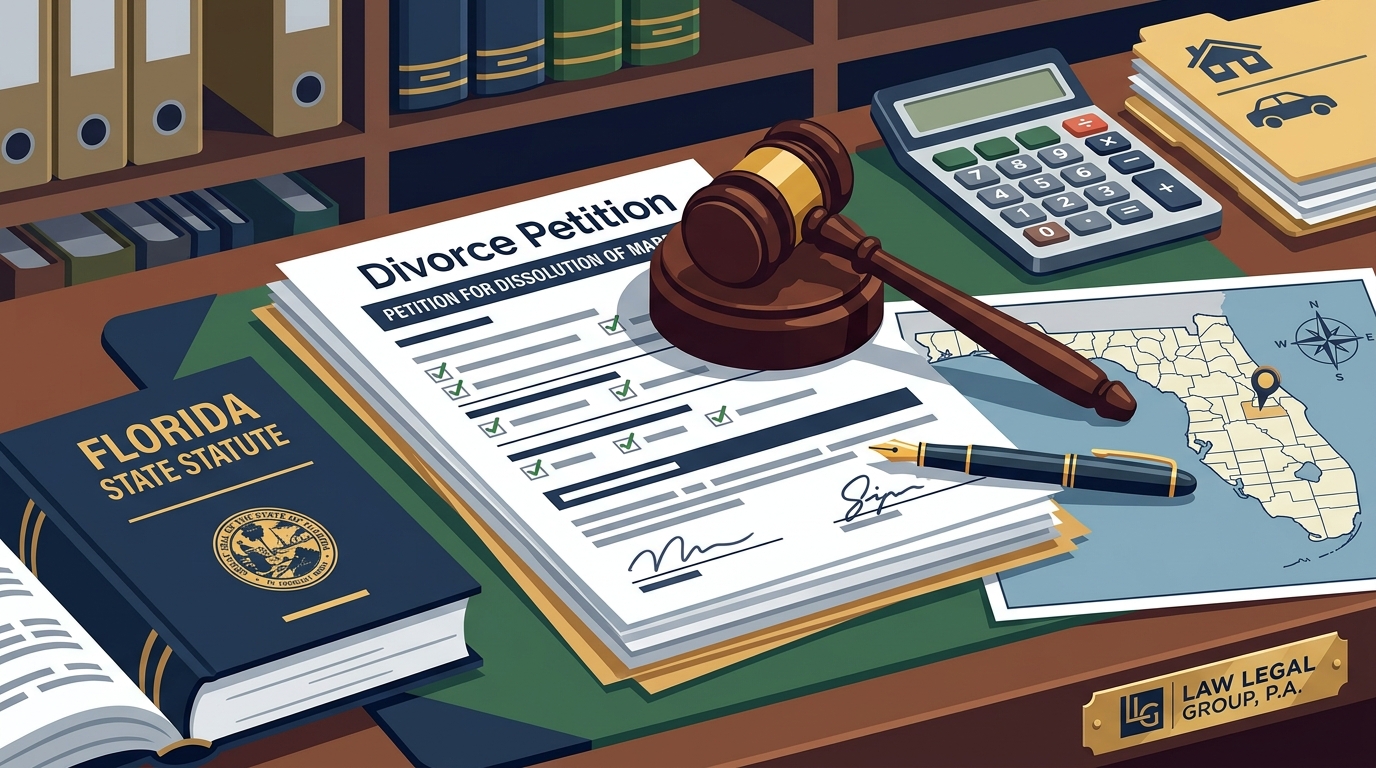
The formal divorce process begins with the preparation and filing of a Petition for Dissolution of Marriage. This document outlines your basic information, the grounds for divorce, and your requests regarding alimony, property division, and child-related matters. In Florida, the standard ground for divorce is that the marriage is "irretrievably broken." This no-fault standard means you do not need to prove wrongdoing by the other party to proceed.
Filing the petition requires submitting the appropriate forms to the circuit court in the county where you or your spouse resides. There is a filing fee associated with this step, which can vary by county. Once filed, the court will assign a case number, and the process moves to the next critical phase.
Service of Process and Response
After filing, the other spouse must be formally notified of the lawsuit. This is known as "service of process." It can be accomplished through a sheriff, a licensed process server, or by agreement if the spouse waives formal service. Proper service is vital because it triggers the legal deadlines for the respondent to answer the petition.
If the spouse fails to respond within twenty days, you may seek a default judgment. However, if they do respond, the case enters the discovery phase. During this stage, both parties exchange information and evidence. Schedule a consultation to discuss how your specific case details might affect the timeline and strategy for service and response.
Financial Disclosure and Asset Division
Florida is an equitable distribution state. This does not necessarily mean a fifty-fifty split, but rather that assets and debts are divided fairly based on various factors. Both spouses are required to complete a mandatory Family Law Financial Affidavit. This document provides a detailed snapshot of income, expenses, assets, and liabilities.
Transparency is critical during this phase. Hiding assets can lead to severe legal penalties and a loss of credibility with the court. The court will consider the duration of the marriage, the economic circumstances of both parties, and contributions to the marriage when determining the final distribution. For complex estates, professional valuation of businesses or real estate may be necessary.
Addressing Child Custody and Support
When children are involved, the court prioritizes their best interests above all else. This includes determining time-sharing schedules, which replace the older concept of "visitation," and legal custody, which involves decision-making rights for education, health, and welfare. Additionally, child support is calculated using a statutory formula that considers both parents' incomes and the number of overnights each parent has.
Parents are encouraged to create a Parenting Plan that outlines these arrangements. If parents cannot agree, the court will impose a plan. Our child custody practice focuses on creating sustainable plans that protect the child's relationship with both parents while ensuring stability.
Settlement vs. Trial Outcomes
Most divorces in Florida are resolved through settlement rather than a full trial. Settlements can be reached through negotiation, mediation, or collaborative law. Mediation is often required by the court before a trial can be scheduled. This process involves a neutral third party helping the spouses reach an agreement.
Going to trial is typically more expensive, time-consuming, and stressful. It leaves the final decision in the hands of a judge rather than the parties themselves. By working with skilled advocates, you can often achieve a more favorable and personalized outcome through settlement. Explore our comprehensive legal services to see how we can guide you toward a resolution.
Key Takeaways
- Florida requires at least one spouse to reside in the state for six months before filing for divorce.
- The primary ground for divorce is that the marriage is "irretrievably broken," making it a no-fault process.
- Equitable distribution means assets are divided fairly, not necessarily equally, based on statutory factors.
- Mandatory financial affidavits must be completed by both parties to ensure full transparency.
- Child custody decisions are based on the "best interests of the child" standard, including time-sharing and support calculations.
- Mediation is often a required step before a case can proceed to a full trial.
- Law Legal Group, P.A. has served the Tampa community since 2014 with a focus on personalized legal strategies.
Frequently Asked Questions
How long does a divorce take in Florida?
The timeline varies significantly based on complexity. Uncontested divorces can be finalized in as little as thirty days after the waiting period expires. Contested cases involving complex assets or custody disputes may take several months or longer.
Do I need a lawyer to file for divorce?
While you can file pro se, family law involves strict procedural rules. An attorney ensures that your rights are protected and that all necessary documents are filed correctly. Contact us to discuss your specific needs.
What is the difference between legal and physical custody?
Legal custody refers to the right to make major decisions for the child. Physical custody, now often referred to as time-sharing, determines where the child sleeps and spends their time.
How is child support calculated?
Child support is calculated using a formula that considers both parents' gross incomes, the number of overnights, health insurance costs, and childcare expenses. The goal is to maintain the child's standard of living.
Can I change my divorce decree after it is finalized?
Yes, but only under specific circumstances. Modifications are generally allowed for child support or time-sharing if there has been a substantial change in circumstances. Alimony modifications depend on the terms of the original agreement.
What is a parenting plan?
A parenting plan is a detailed document outlining how parents will share responsibilities and time with their children. It must include provisions for decision-making, time-sharing schedules, and dispute resolution.
Is mediation mandatory in Florida divorces?
In many counties, yes. Courts often require parties to attempt mediation before allowing a case to go to trial. This helps reduce court congestion and encourages amicable resolutions.
What are the filing fees for divorce?
Filing fees vary by county but typically range from $400 to $500. Additional fees may apply for service of process or other court costs.
Contact Law Legal Group for Expert Guidance
Navigating a divorce requires precision, empathy, and strategic foresight. At Law Legal Group, P.A., we provide the dedicated representation you need during this challenging time. Our team is committed to protecting your rights and securing the best possible outcome for you and your family.
Do not face this process alone. Book a consultation today to discuss your case with our experienced attorneys. We are located at 113 South Boulevard, Tampa, FL 33606, and can be reached at 813-443-8342.