
Deciding how to end a marriage is one of the most complex legal challenges a person can face. In Florida, the distinction between divorce and legal separation is not merely semantic; it fundamentally alters your financial future, parental rights, and ability to remarry. According to recent legal analyses of family court filings, the majority of marital dissolutions in the state are finalized through the divorce process, yet many individuals remain unaware that legal separation is not a standard option under Florida statutes. Understanding these legal pathways is critical before filing any paperwork. This guide breaks down the essential differences, procedural requirements, and strategic implications of each path to help you make an informed decision. (About Us Lawlegalgroup)
What Is Divorce in Florida?
Divorce, legally known as dissolution of marriage, is the judicial termination of a marital relationship. In Florida, this process is governed by specific statutes that dictate how assets, debts, and parental responsibilities are handled. Florida is a no-fault divorce state, meaning that neither spouse is required to prove wrongdoing such as adultery or abuse to obtain a divorce. The only legal ground required is that the marriage is irretrievably broken. (Law Legal Group P)
The divorce process typically involves several critical stages. First, one spouse files a Petition for Dissolution of Marriage with the circuit court in their county. The other spouse must respond within 20 days. During this period, both parties engage in discovery, where financial documents are exchanged. If the parties cannot agree on terms, the case may proceed to mediation or trial. Once a final judgment is entered by the judge, the marriage is legally ended, and both parties are free to remarry. (Alimony Lawlegalgroup)
At Law Legal Group, P.A., we handle every aspect of the dissolution process, from initial filing to final judgment. Our team ensures that your rights are protected during the discovery phase and that any settlement agreements are drafted to prevent future litigation. We understand that divorce is not just a legal procedure but a life transition that requires careful strategic planning. (Adoption Lawlegalgroup)
The Status of Legal Separation
Unlike many other jurisdictions, Florida does not recognize legal separation as a formal legal status. There is no statute that allows a couple to live apart while remaining legally married with court-enforced rights and obligations regarding property and support. This is a critical distinction that often surprises individuals who have lived in states where legal separation is a viable option.
Because legal separation is not available, couples who wish to live apart must rely on other legal mechanisms. The most common alternative is a separate maintenance action. This is a lawsuit filed by one spouse against the other for financial support while remaining married. However, separate maintenance does not divide property or end the marital status. It is primarily used to establish temporary support obligations.
Another option is a postnuptial agreement. This is a contract entered into by married couples that defines their financial rights and responsibilities. While it does not create a legal status of separation, it can outline how assets would be divided if a divorce were to occur later. For complex financial situations, a well-drafted postnuptial agreement can provide clarity and protection. Learn more about our prenuptial and postnuptial agreement services to understand how these contracts work.
Key Differences at a Glance
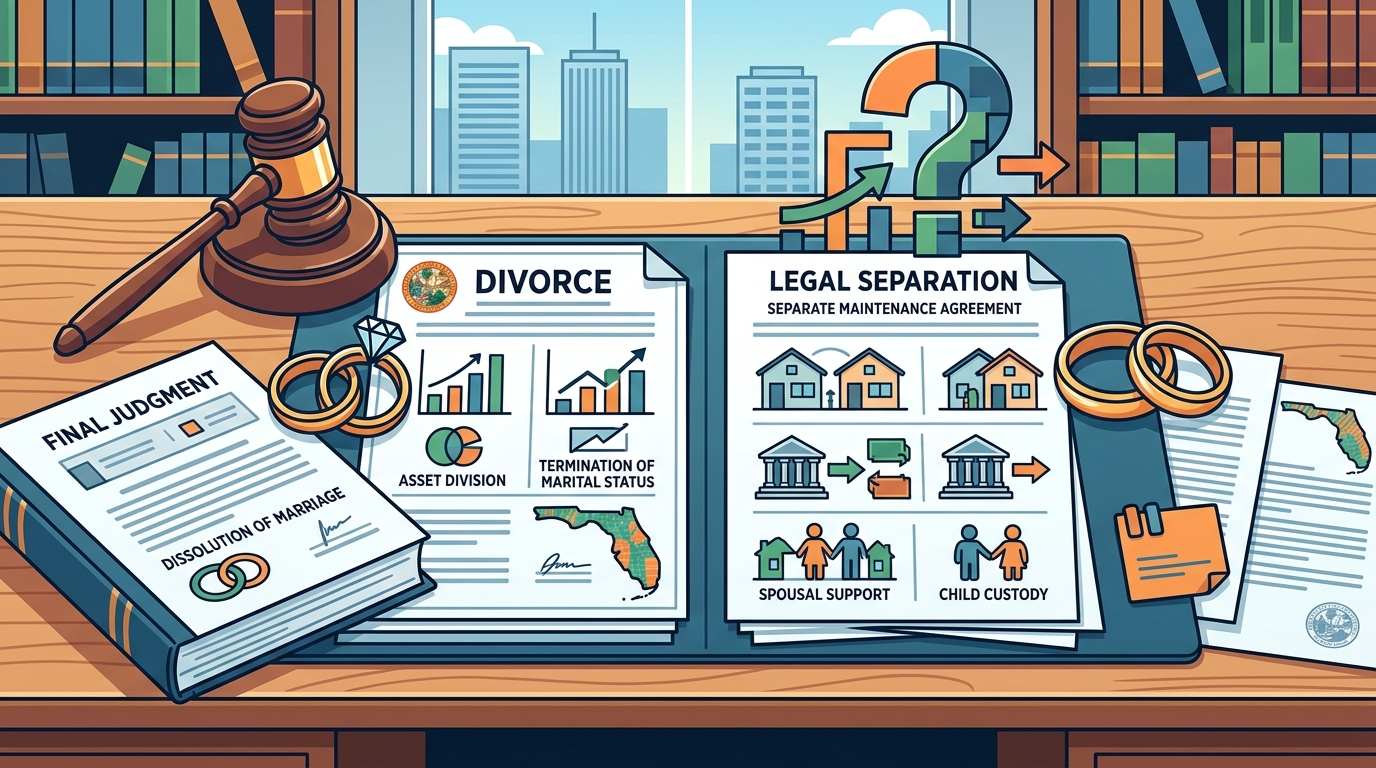
Understanding the structural differences between divorce and the alternatives to separation is vital for strategic planning. The table below summarizes the core distinctions between dissolving a marriage and attempting to live apart without divorce.
| Feature | Divorce (Dissolution) | Legal Separation (Not Available in FL) | Separate Maintenance |
|---|---|---|---|
| Marital Status | Legally single | N/A | Still legally married |
| Remarriage | Allowed immediately | N/A | Prohibited |
| Property Division | Equitable distribution | N/A | Not divided |
| Debt Liability | Allocated by court | N/A | Remains joint |
| Child Custody | Parenting plan established | N/A | Can be established |
As shown in the table, the primary advantage of divorce is the finality it provides. Once the judgment is entered, all financial ties are severed, and both parties are free to move forward. In contrast, separate maintenance leaves the marital bond intact, which can complicate future financial decisions and remarriage.
Property Division and Alimony
One of the most significant differences between divorce and remaining separated is how property and debts are handled. In a divorce, Florida courts apply the principle of equitable distribution. This does not necessarily mean a 50/50 split, but rather a fair division based on factors such as the duration of the marriage, the economic circumstances of each party, and contributions to the marriage.
Equitable distribution covers all marital assets and marital liabilities. This includes real estate, retirement accounts, businesses, and debts incurred during the marriage. The court has the power to assign specific assets and debts to each spouse. This finality is crucial for financial independence.
In a separate maintenance action, the court does not divide property. The couple remains financially intertwined. This can be problematic if one spouse accumulates debt in the other's name or if one spouse hides assets. For this reason, many individuals prefer divorce to ensure a clean break. Our attorneys at Law Legal Group, P.A. specialize in complex property division cases, ensuring that your interests are fully represented during negotiations.
Alimony, or spousal support, is also handled differently. In a divorce, the court can award various forms of alimony, including bridge-the-gap, rehabilitative, durational, or permanent alimony, depending on the needs of the recipient and the ability of the payer. In a separate maintenance action, support is typically temporary and limited to the period of separation. It does not provide the long-term structure that divorce alimony can offer.
Child Custody and Support
When children are involved, the legal status of the parents directly impacts custody and support arrangements. In a divorce, the court establishes a parenting plan and a child support schedule. The parenting plan outlines physical custody (time-sharing) and legal custody (decision-making authority). The child support amount is calculated using a statutory formula based on both parents' incomes and the number of overnights.
In a separate maintenance action, the court can also establish a parenting plan and child support. However, because the marriage is not dissolved, certain legal implications remain. For example, if one parent dies, the other may still have inheritance rights. Additionally, the child support obligation may be modified more easily if the separation ends and the couple reconciles.
For families navigating these complex issues, child custody and child support require precise legal drafting. Our team works closely with clients to ensure that any parenting plan is in the best interest of the child and is enforceable. We also handle paternity cases to establish parental rights when the parents were not married.
Choosing the Right Path
Deciding between divorce and remaining separated (via separate maintenance) depends on your specific circumstances. Some couples choose separate maintenance for religious reasons, to maintain health insurance benefits, or to give their marriage a chance to heal. However, this path carries significant financial risks due to the lack of property division.
Divorce is often the preferred route for those seeking finality and financial independence. It allows both parties to start fresh without the legal entanglements of marriage. If you are considering divorce, it is essential to have experienced legal counsel. Schedule a consultation with Law Legal Group, P.A. to discuss your options.
Our firm provides personalized legal strategies tailored to your unique situation. We understand that every family is different, and we are committed to providing compassionate support throughout the process. Whether you need assistance with alimony, domestic violence restraining orders, or relocation cases, we are here to help.
Key Takeaways
- Florida Law: Florida does not have a formal legal separation status; couples must use divorce or separate maintenance.
- Divorce Finality: Divorce legally ends the marriage, allows remarriage, and divides all marital assets and debts.
- Separate Maintenance: This is a lawsuit for support while remaining married; it does not divide property.
- Equitable Distribution: Florida courts divide marital assets fairly, not necessarily equally, during a divorce.
- Child Custody: Both divorce and separate maintenance can establish parenting plans and child support.
- Alimony Options: Divorce offers various long-term alimony structures, while separate maintenance is typically temporary.
- Legal Counsel: Experienced attorneys are crucial for navigating complex property and custody issues.
Frequently Asked Questions
Can I get a legal separation in Florida?
No, Florida does not recognize legal separation as a formal legal status. Couples who wish to live apart must either file for divorce or pursue a separate maintenance action for financial support while remaining married.
What is the difference between divorce and legal separation?
Divorce legally terminates the marriage, allowing both parties to remarry and dividing all assets and debts. Legal separation (where available) allows couples to live apart while remaining married, but this option is not available in Florida.
How is property divided in a Florida divorce?
Florida uses the principle of equitable distribution. This means the court divides marital assets and debts fairly, based on factors such as the duration of the marriage and each spouse's contributions, but not necessarily equally.
Can I get child support if I am separated but not divorced?
Yes, you can file a separate maintenance action to seek child support and a parenting plan while remaining married. However, this does not resolve property division or debt liability.
How long does a divorce take in Florida?
The timeline varies depending on the complexity of the case. Uncontested divorces can be finalized in as little as 20 days after filing, while contested cases may take several months or longer.
What is a parenting plan?
A parenting plan is a court-approved document that outlines how parents will share time with their children and make decisions regarding the child's welfare. It is required in all Florida divorce cases involving minor children.
Do I need a lawyer for a divorce?
While it is possible to file for divorce without a lawyer, it is highly recommended, especially if there are children, significant assets, or complex financial issues. An experienced attorney can protect your rights and ensure a fair outcome.
Take Control of Your Future
Deciding how to end a marriage is a pivotal moment in your life. Whether you choose divorce or another legal path, having the right legal representation is essential. At Law Legal Group, P.A., we provide the expertise and compassion you need during this challenging time. Our team is dedicated to achieving the best possible outcome for you and your family.
Contact us today to schedule your consultation. We are located at 113 South Boulevard, Tampa, FL 33606, and can be reached at 813-443-8342. Let us help you navigate the complexities of family law with confidence and clarity.