

Understanding the distinction between marital and separate property is the single most critical factor in determining the financial outcome of a divorce in Florida. Florida is an equitable distribution state, which means courts divide assets fairly, though not necessarily equally. According to the Florida Supreme Court, the classification of assets as marital or non-marital determines whether they are subject to division. This classification process can significantly impact the final settlement, often altering the financial landscape for both parties involved in the dissolution of marriage. (About Us Lawlegalgroup)
Defining Marital Property in Florida
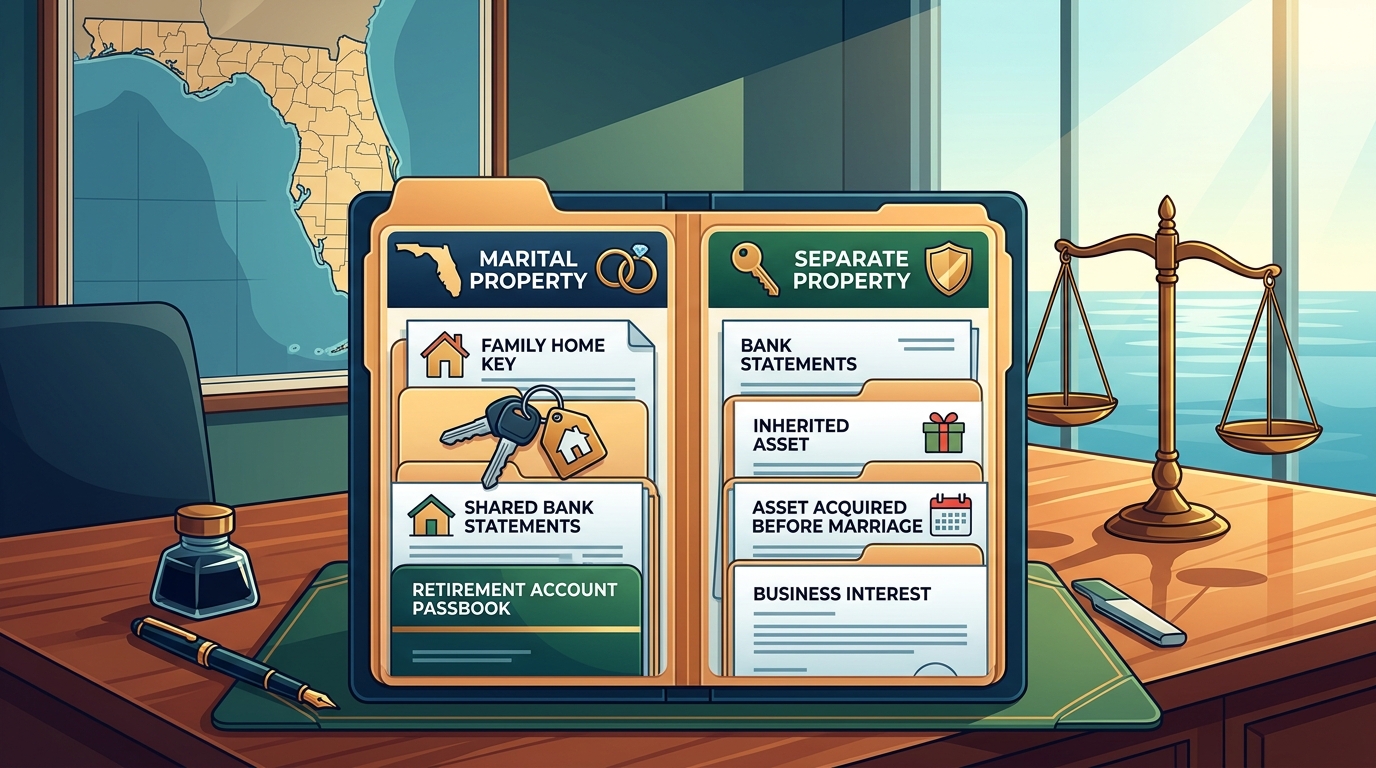
Marital property is broadly defined as any asset acquired by either or both spouses during the marriage. This definition is expansive and includes income earned, real estate purchased, and retirement accounts funded while the couple was legally married. The key determinant is the timing of the acquisition relative to the date of marriage. (Law Legal Group P)
Marital property is subject to equitable distribution by the court. This means that regardless of whose name is on the title or deed, the asset is considered part of the marital estate. For example, if one spouse purchased a vacation home during the marriage using joint funds, it is marital property even if only one name appears on the deed. The Law Legal Group, P.A. emphasizes that accurate identification of these assets is the first step in any fair division.
Several categories of assets are typically classified as marital property:
- Real Estate: Primary residences, vacation homes, and investment properties purchased during the marriage.
- Retirement Accounts: 401(k)s, IRAs, and pension plans funded during the marriage.
- Business Interests: Any increase in value of a business owned by either spouse during the marriage.
- Personal Property: Vehicles, furniture, and artwork acquired during the marriage.
For a deeper understanding of how property division is handled, you can explore our property division services to see how we approach complex asset splits.
Identifying Separate Property
Separate property, also known as non-marital property, is not subject to division in a divorce. It remains the sole property of the spouse who owns it. To qualify as separate property, the asset must meet specific legal criteria established by Florida Statute 61.075.
Separate property is defined as assets acquired before the marriage, or assets acquired during the marriage by gift, devise, or bequest. It also includes any appreciation or income derived from these assets, provided that the appreciation is not due to the active efforts of either spouse during the marriage. This distinction is crucial for high-net-worth individuals who bring significant assets into a marriage.
Common examples of separate property include:
- Pre-marital Assets: Real estate or investments owned solely by one spouse before the wedding.
- Inheritances: Money or property inherited by one spouse during the marriage, provided it is kept separate.
- Gifts: Personal gifts given to one spouse by a third party, such as a family heirloom.
If you are concerned about protecting your pre-marital assets, it is advisable to consult with an experienced attorney. You can schedule a consultation to discuss your specific situation and how to best protect your interests.
The Danger of Commingling Assets
One of the most common pitfalls in Florida divorce cases is the commingling of separate and marital property. Commingling occurs when separate assets are mixed with marital assets to such an extent that they become indistinguishable. Once commingled, the separate property may lose its protected status and become subject to division.
For instance, if you deposit an inheritance (separate property) into a joint checking account used for household expenses, that money may be considered marital property. Similarly, if you use marital funds to pay down the mortgage on a pre-marital home, the portion of the home paid off with marital funds becomes marital property.
To avoid commingling, it is essential to maintain separate bank accounts for separate assets. Keep clear records of the source of funds and avoid using marital funds to improve or maintain separate property without a clear agreement. The Law Legal Group, P.A. advises clients to document all financial transactions meticulously to preserve the character of their separate assets.
Handling Marital Debt
Just as assets are divided, so too are debts incurred during the marriage. Marital debt includes any liability incurred by either or both spouses during the marriage, regardless of whose name is on the account. This can include credit card debt, mortgages, car loans, and personal loans.
The court will equitably distribute marital debt between the spouses. This does not necessarily mean a 50/50 split. The court considers various factors, including the economic circumstances of each party, the duration of the marriage, and any interruptions to careers or education. It is important to note that even if one spouse is assigned a debt in the divorce decree, creditors may still pursue the other spouse if their name is on the account.
For more information on how we handle complex financial disputes, review our services page to learn about our comprehensive legal support.
Valuation and Appraisal Processes
Accurate valuation of assets is a critical component of property division. Disputes often arise over the value of businesses, real estate, and retirement accounts. In Florida, the valuation date is typically the date of the marital petition or another date as determined by the court.
For complex assets like businesses, a forensic accountant may be necessary to determine the fair market value. Real estate is usually appraised by a licensed appraiser. Retirement accounts may require a Qualified Domestic Relations Order (QDRO) to divide the assets without tax penalties.
At the Law Legal Group, P.A., we work with financial experts to ensure that all assets are valued accurately and fairly. This ensures that the division of property reflects the true worth of the marital estate. For guidance on valuation strategies, contact our Tampa office today.
Key Takeaways
- Equitable Distribution: Florida courts divide marital property fairly, not necessarily equally, based on statutory factors.
- Timing is Key: Assets acquired during the marriage are generally marital, while those acquired before are separate.
- Inheritances and Gifts: These are separate property if kept distinct from marital assets.
- Commingling Risks: Mixing separate and marital funds can convert separate property into marital property.
- Debt Division: Marital debt is divided equitably, but creditors may still pursue both spouses.
- Valuation Matters: Accurate appraisal of assets is essential for a fair division of the marital estate.
- Legal Counsel: Experienced attorneys can help protect your separate assets and ensure a fair outcome.
Frequently Asked Questions
Is a house bought before marriage considered marital property?
No, a house purchased before the marriage is generally considered separate property. However, if marital funds are used to pay the mortgage or improve the property, the marital portion may be subject to division.
How are retirement accounts divided in a Florida divorce?
The portion of retirement accounts accumulated during the marriage is marital property and is subject to division. A Qualified Domestic Relations Order (QDRO) is often used to divide these accounts without tax penalties.
Can I keep my inheritance separate from my spouse?
Yes, inheritances are separate property if kept in a separate account and not commingled with marital funds. It is crucial to maintain clear records to prove the separate nature of the inheritance.
What happens to business interests during a divorce?
The portion of a business interest acquired or increased in value during the marriage is marital property. A forensic accountant may be needed to determine the fair market value of the business.
Does my name on the deed matter for property division?
No, the name on the deed does not determine whether property is marital or separate. In Florida, assets acquired during the marriage are marital property regardless of whose name is on the title.
How is debt divided in a Florida divorce?
Marital debt is divided equitably by the court. This means the court considers various factors to determine a fair distribution, which may not be equal.
What is the statute of limitations for claiming separate property?
There is no specific statute of limitations for claiming separate property in a divorce. However, it is important to assert your claim early in the proceedings and provide clear evidence of the separate nature of the assets.
Secure Your Financial Future
Divorce is a complex legal process that requires careful attention to detail, especially when it comes to property division. The Law Legal Group, P.A. is dedicated to providing personalized legal strategies that protect your rights and interests. Whether you are dealing with complex assets, business interests, or high-conflict disputes, our team is here to help.
Do not navigate this challenging time alone. Contact the Law Legal Group, P.A. today to schedule a consultation and learn how we can assist you. Visit our book online page to get started.