

Florida operates as an equitable distribution state, which fundamentally alters how assets are divided compared to community property jurisdictions. According to the Florida Bar, the court must first classify all assets and liabilities as either marital or separate before determining a fair distribution. This classification process is not merely academic; it dictates the entire financial outcome of the dissolution. Misunderstanding these boundaries often leads to significant financial losses for spouses who assume all assets acquired during the marriage are automatically split fifty-fifty. The reality is far more nuanced, relying on the source of funds, the timing of acquisition, and the intent of the parties involved. (About Us Lawlegalgroup)
Defining Marital Property in Florida
Marital property is the cornerstone of equitable distribution in Florida. The law defines this category broadly to ensure that both parties share in the wealth built during the marriage. Marital property is any asset acquired by either party during the marriage. This includes real estate, bank accounts, retirement funds, and business interests, regardless of whose name is on the title. The key factor is the timing of the acquisition relative to the date of the marriage. (Law Legal Group P)
Income earned by either spouse during the marriage is also considered marital property. This means that even if one spouse stayed home to raise children while the other worked, the income generated by the working spouse is subject to division. The Florida courts view marriage as an economic partnership where both parties contribute, whether through financial earnings or non-financial domestic support. Consequently, the appreciation of separate property assets during the marriage can also become marital if marital efforts or funds contributed to that growth. (Alimony Lawlegalgroup)
There are specific exceptions to this rule. Assets acquired by gift or inheritance to one spouse alone remain separate, provided they are not commingled. However, if a spouse deposits an inheritance into a joint bank account used for household expenses, the court may presume it has been transmuted into marital property. This presumption is difficult to overcome without clear and convincing evidence of intent to keep the asset separate. (Adoption Lawlegalgroup)
Identifying Separate Property
Separate property is defined as assets that belong exclusively to one spouse and are not subject to division. Separate property is any asset acquired before the marriage, or by gift or inheritance during the marriage to one spouse alone. This category also includes any passive appreciation of these assets, meaning growth that occurs without the active effort or financial contribution of the other spouse.
For example, if one spouse owned a home prior to the marriage and the home's value increased solely due to market conditions, that increase is typically considered separate. However, if the couple used marital funds to pay down the mortgage or made significant improvements that increased the value, the portion of the appreciation attributable to those marital efforts becomes marital property. This distinction requires careful financial analysis and often expert testimony.
Another critical aspect of separate property is the requirement of non-commingling. Commingling occurs when separate assets are mixed with marital assets to the point where they can no longer be distinguished. If you deposit separate funds into a joint account and use it for daily expenses, tracing those funds becomes nearly impossible. The Law Legal Group, P.A. advises clients to maintain strict separation of pre-marital assets to preserve their status as separate property.
The Burden of Proof and Tracing
In Florida divorce proceedings, the burden of proof lies with the spouse claiming that an asset is separate property. This is a significant legal hurdle. You must provide clear and convincing evidence that the asset was acquired before the marriage or through a valid gift or inheritance. The standard of "clear and convincing evidence" is higher than the preponderance of the evidence standard used in many civil cases.
Tracing is the primary method used to satisfy this burden. Tracing involves following the flow of funds from their source to their current location. For instance, if you sold a pre-marital home and used the proceeds to buy a new property, you must show that the funds remained separate throughout the transaction. This requires meticulous record-keeping and often the assistance of forensic accountants.
Without proper tracing, courts will presume that all assets acquired during the marriage are marital. This presumption is strong and difficult to rebut. It is essential to document the source of all funds used to acquire assets during the marriage. If you are unsure about the status of your assets, consulting with an experienced attorney is crucial to protect your interests.
Common Asset Disputes and Scenarios
Disputes over property classification are among the most contentious aspects of divorce. One common issue involves the family home. If the home was purchased before the marriage but marital funds were used for mortgage payments, the non-owner spouse may have a claim to the portion of the equity attributable to those payments. This is known as the "Lassiter" formula, named after a key Florida case.
Business interests present another complex challenge. If one spouse owns a business before the marriage, the business itself is separate property. However, the active appreciation of the business during the marriage is marital property. Determining the value of the business and separating the passive from the active appreciation requires expert valuation and legal strategy.
Retirement accounts are also frequent sources of dispute. Contributions made to a 401(k) or IRA during the marriage are marital property, even if only one spouse contributed. The division of these accounts is handled through a Qualified Domestic Relations Order (QDRO), which ensures tax-efficient transfer of funds. Understanding the implications of a QDRO is vital to avoid unexpected tax liabilities.
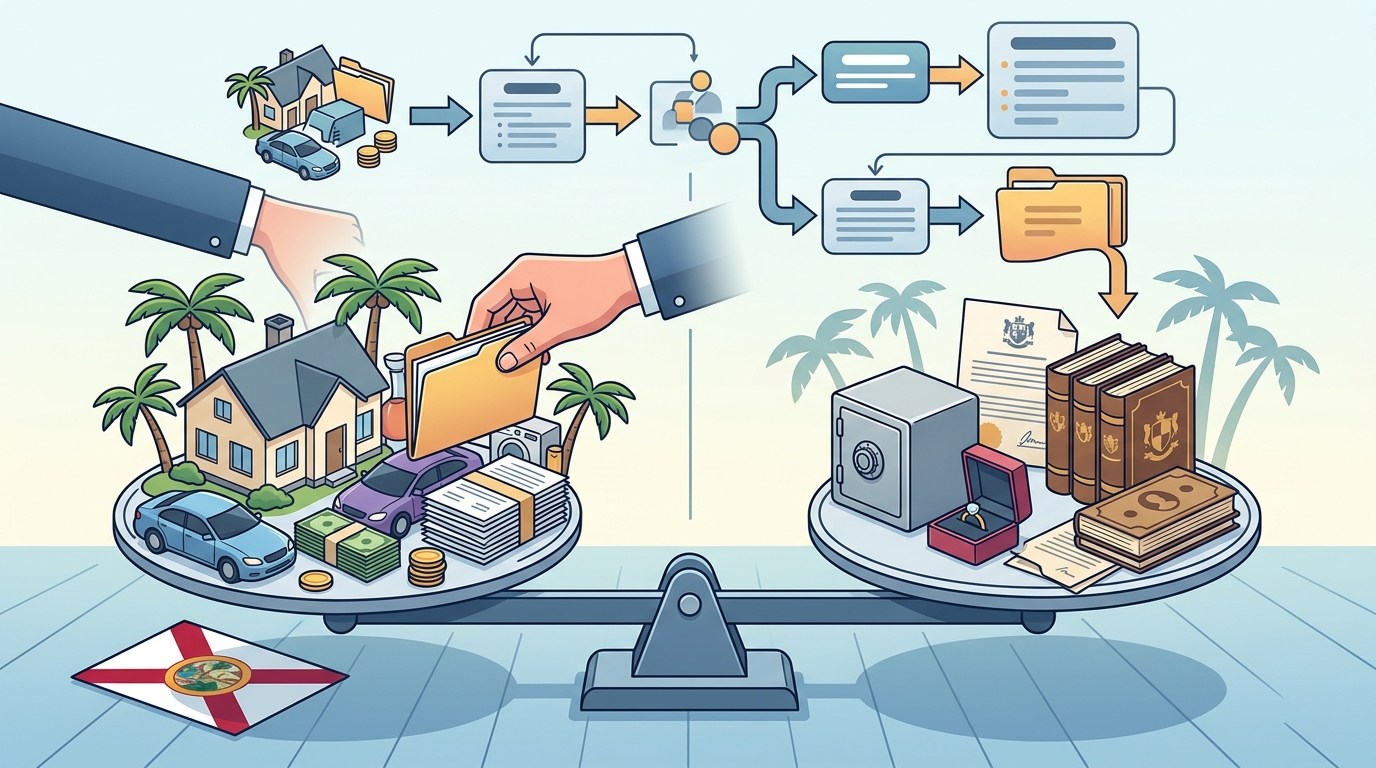
Asset Classification Comparison
The following table summarizes the general rules for classifying common assets in a Florida divorce. This overview is for informational purposes and does not constitute legal advice. Each case is unique and depends on specific facts and evidence.
| Asset Type | Typical Classification | Key Determining Factor |
|---|---|---|
| Pre-marital Home | Separate (with exceptions) | Use of marital funds for improvements or mortgage payments. |
| Inheritance | Separate | Must remain in a separate account and not be commingled. |
| Gift to One Spouse | Separate | Must be clearly intended for one spouse only. |
| Salary Earned During Marriage | Marital | Acquired during the marriage regardless of who earned it. |
| Business Interest | Hybrid | Pre-marital value is separate; active appreciation is marital. |
| Retirement Accounts | Marital (portion) | Contributions made during the marriage are marital property. |
Key Takeaways
- Equitable Distribution: Florida divides marital property fairly, not necessarily equally, based on various statutory factors.
- Marital Property Definition: Assets acquired during the marriage are presumed marital, regardless of title.
- Separate Property Definition: Assets acquired before marriage or via gift/inheritance are separate if kept distinct.
- Commingling Risk: Mixing separate funds with marital funds can transmute separate property into marital property.
- Burden of Proof: The spouse claiming separate property must provide clear and convincing evidence.
- Active Appreciation: Growth in separate assets due to marital effort or funds becomes marital property.
- Legal Counsel: Complex asset division requires experienced legal representation to protect your financial future.
Frequently Asked Questions
Is my spouse entitled to my inheritance in a Florida divorce?
Inheritance is generally considered separate property if it is kept in a separate account and not commingled with marital assets. However, if you use inheritance funds to purchase a marital home or pay off marital debts, it may be transmuted into marital property.
How is the family home divided in Florida?
If the home was purchased during the marriage, it is marital property and subject to division. If one spouse owned it before the marriage, the pre-marital equity is separate, but any appreciation due to marital efforts or funds may be marital. The court may award the home to one spouse or order its sale.
What is the statute of limitations for claiming separate property?
There is no specific statute of limitations for claiming separate property in a divorce, but the burden of proof is on the spouse making the claim. It is crucial to document the source of funds and maintain clear records throughout the marriage.
Can my spouse claim my pre-marital business as marital property?
The pre-marital value of the business is separate property. However, the active appreciation of the business during the marriage is marital property. This requires a detailed valuation to separate the passive growth from the growth due to marital effort.
What happens if we commingled our separate funds?
Commingling can make it difficult to trace separate funds. If the funds are mixed beyond recognition, the court may presume the entire asset is marital property. Clear and convincing evidence is required to overcome this presumption.
Do I have to pay taxes on the division of assets?
Generally, the transfer of property incident to divorce is tax-free under IRS rules. However, the division of retirement accounts requires a QDRO to avoid early withdrawal penalties. Consult a tax professional for specific advice.
How does the Law Legal Group, P.A. help with property division?
We provide strategic legal advice to protect your assets, ensure accurate classification, and negotiate fair settlements. Our team has over a decade of experience in Florida family law and is dedicated to achieving the best possible outcome for our clients.
Schedule Your Consultation
Navigating the complexities of property division requires precision and experience. The Law Legal Group, P.A. is committed to providing the personalized attention and strategic advocacy you need. We understand that every case is unique, and we tailor our approach to meet your specific goals. Contact us today to schedule a consultation and protect your financial future.
Book a Consultation with our experienced team at 113 South Boulevard, Tampa, FL 33606. Call us at 813-443-8342 to discuss your case.